


Gold Winner In The Category Material
A mattress is returned to Decathlon every eight minutes. The real bottleneck in the repair process has never been the repair itself, but rather the often tedious and unclear search for the leak. It is precisely this uncertainty that has previously hindered any scaling of circular economy applications like repairs, second hand, buyback or rent.
The new real-time leak detection system using an acoustic camera solves this problem: the time-consuming process of finding the leak is transformed into a fast, precise procedure, making scalable, circular models accessible for the first time.
What convinced the jury:
★ Fast, simple, and precise leak detection:
Inflate, detect the leak and deflate under 2 minutes.
★ Enables scalable repair and reuse:
Makes the reliable repair of inflatable products efficient, thereby supporting rental, resale, and circular economy models.
★ Impact on waste and CO₂ reduction:
Transforms single-use inflatable items into reusable products, reduces waste, and avoids emissions through extended product lifecycles.
Jury Statement:
Decathlon has developed a powerful solution that makes the repair of leak-prone products fast, reliable, and efficient. By precisely locating leaks in just a few seconds, the system significantly simplifies diagnosis for store teams. This makes repairs not only feasible but also scalable, paving the way for stronger rental, resale, and reuse models while simultaneously extending the lifespan of inflatable outdoor equipment.
Product Scoring:
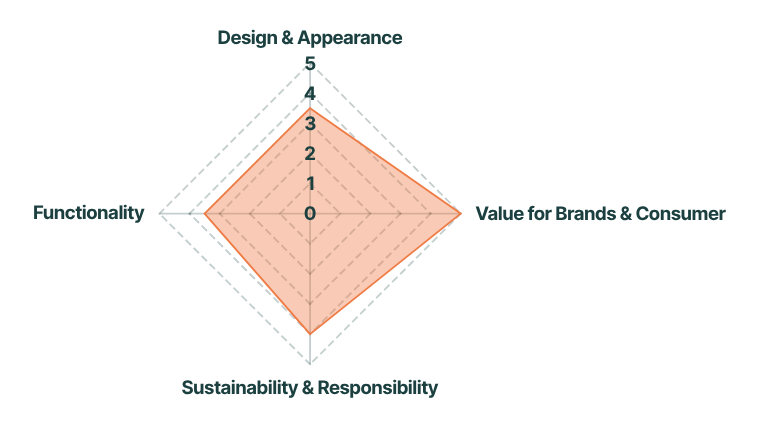
1:48 minutes for scalable repair of matrasses
The decisive leap lies in the speed and clarity of the diagnosis: In just 1 minute and 48 seconds, the procedure inflates, detects the leak and deflates inflatable equipment. What used to be “Mission Impossible”. – finding an air leak – becomes a precise, immediately visible analysis.
This creates a new service model that makes repair, resale, and trust in the retail sector scalable in the first place. Because inflatable products are difficult to recycle; this Extends the life of these products and allows them to reduce their carbon footprint.
Product Specification:
Industrial acoustic imaging: A process that uses sound waves to visualize or “image” processes or defects in technical systems

Innovative industrial acoustic imaging
The technology itself is based on industrial acoustic imaging but has been specifically adapted for outdoor equipment. Complemented by custom-made, 3D-printed adapters for all valve systems, and adapted inflating/deflating systems, it integrates seamlessly into existing sales and repair processes. The result is not a new product in the traditional sense, but a new systemic approach to maintenance – fast, precise, and fully geared toward the circular economy.
Intended Use
The acoustic diagnostic technology is used wherever troubleshooting inflatable outdoor equipment has previously caused significant time and uncertainty – such as with mattresses, kayaks, SUPs, or tents. Instead of time-consuming tests, the system provides a precise, visual leak diagnosis in just a few minutes.
In-store, this enables a streamlined process: returns are quickly inspected and immediately directed to repair, resale, or reuse. This saves time, reduces unnecessary write-offs, and makes repairs efficiently scalable for the first time.
For customers, this means greater transparency and quick solutions instead of uncertainty.
The service will be launched in select Decathlon stores in 2027.
More about Simond
