


Sport, Health and Wellness are no longer separate worlds – they are merging into one connected market. Consumers track sleep, recovery and training. Fitness is becoming identity. Prevention is gaining relevance as healthcare systems come under pressure. At the same time, brands are building ecosystems around movement, community and data. This shift is at the core of the new Future of Sports Hub Healthtech Trendreport by Max Gaub.
Get all key numbers, insights & cases:
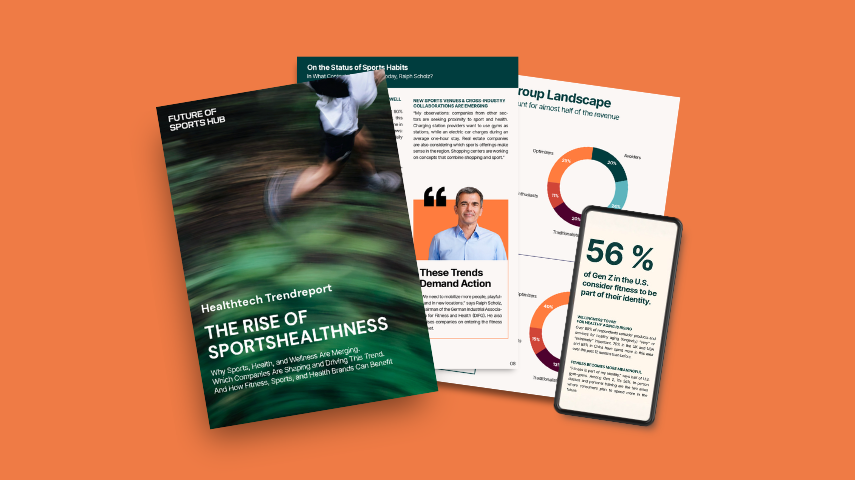
The report looks at the status quo of societal health, the science of movement, market dynamics, changing fitness habits and the companies already shaping this shift. It includes expert perspectives and company examples from Myoact, Reboots, EGYM and HYROX, as well as insights from Ingo Froböse, Ralph Scholz, Alina Buchner, A’Naja Newsome, Simon Roth, Alexander Engelhardt, Philipp Roesch-Schlanderer, Moritz Fürste and Christian Toetzke.
A society under pressure: older, heavier, more stressed
The report starts with a simple but important question: how healthy are we really?
Several signals point in the same direction. Populations are getting older. Obesity is rising globally. Mental health-related work disability has increased significantly in Germany. At the same time, many people sit for more than ten hours a day, while only a minority compensate for this through enough physical activity.
The report also highlights a striking gap: health awareness is growing, but health literacy remains weak. That creates a challenge for healthcare, but also an opportunity for the sports and fitness sector.
The key question is no longer only how to make people train harder. It is how to make movement more accessible, understandable and relevant in everyday life.
As Dr. Hans Henri P. Kluge, WHO Regional Director for Europe, puts it in the report: everyone working in sport and physical activity has a role to play – from urban planners and municipalities to fitness clubs and sports associations.
Why muscles are more than motors
One of the strongest parts of the report is the science perspective from Ingo Froböse. His central point: muscles are not only mechanical systems. They are active organs with preventive and therapeutic relevance.
The report explains how muscles release signaling molecules, so-called myokines, which can support prevention and play a role in relation to cardiovascular disease, diabetes and osteoporosis. It also points to the growing importance of strength training for older people, especially because muscle mass declines with age.
This shifts the role of sport. Movement becomes more than leisure, competition or aesthetics. It becomes part of prevention, healthy ageing and mental wellbeing.
For brands, clubs and fitness providers, that changes the narrative. The future of fitness communication will not only be about performance, body shape or motivation. It will increasingly be about function, independence, recovery, resilience and long-term health.
 @George Dagerotip
Healthification: wellness becomes an active task
Consumers are taking a more active role in their own health. Home diagnostic kits, longevity products, personalized wellness offers and data-driven fitness services are becoming more relevant. In the US, 56% of Gen Z gym-goers consider fitness part of their identity. That is not a small lifestyle detail. It shows how deeply sport and wellbeing are becoming connected to self-image, community and consumption.
For brands, this creates a more competitive market. If health becomes part of everyday identity, consumers expect products and services that are more personal, more credible and more useful.
Alina Buchner, Associate Partner at McKinsey, argues in the report that clear positioning, personalized offerings, loyalty programs and community models are becoming important tools in a crowded wellness market.
The implication is clear: generic wellness messaging will not be enough. Brands need to understand which audience they serve, what problem they solve and why their offer deserves attention.
Wearables and biodata: more measurement, more responsibility
Wearables are now part of everyday sport and wellness culture. According to the report, around 50% of respondents have already purchased wearables, while more than 75% are open to using them in the future.
But the next question is not only who collects data. It is who understands it.
The report includes an important perspective from A’Naja Newsome, Health Scientist at the University of Central Florida and fitness coach. Her point: users need to learn how to interpret data in context. One bad run, one low readiness score or one unusual sleep metric should not define a training decision. Trends over weeks and months matter more than isolated daily values.
This is a useful reminder for the sports and health industry. Data alone does not create better behaviour. The value lies in interpretation, guidance and trust.
That is also where brands can build stronger relationships: by helping users understand what their data means and how to act on it.
@Johannes KopfNew audiences are changing the market
The report also shows why the market can no longer be addressed as one large wellness audience.
Women’s health, menopause solutions, healthy ageing, sleep, stress management, Gen Z fitness behaviour and corporate health all create different needs. Older consumers require different messaging than young optimizers. Enthusiasts expect community and experience. Traditionalists may prefer simple and practical solutions. Strugglers may need low-barrier, gamified formats.
The report’s target group landscape is especially useful for brands. It shows that Optimizers and Enthusiasts together account for more than half of the market revenue, while Avoiders, Strugglers and Traditionalists follow very different motivations and barriers.
That means the same product can require different narratives, depending on the audience.
A recovery tool can be about performance for endurance athletes, independence for older users, stress relief for busy professionals or routine-building for health-conscious consumers.
What companies are already doing
The strongest part of the report is that it does not stop at trends. It shows how companies are already translating the shift into products, services and ecosystems.
- Myoact uses EMG sensors to make muscle activity visible. Its goal is to support prevention, help physiotherapists and make training and therapy more measurable.
- Reboots shows how recovery has moved from a sports gadget into a lifestyle and performance topic. The company connects compression massage, cold therapy, longevity, biohacking and individualized recovery routines.
- EGYM is building an ecosystem around connected fitness equipment and corporate fitness. The company’s vision is to shift healthcare from repair to prevention by linking gyms, employers and health-oriented training.
- HYROX represents a different but equally relevant part of the trend: turning fitness into a shared, measurable event experience. It combines training, competition, community and social visibility in a standardized format.
Download the full Healthtech Trendreport
Download the full report to understand what the data means for sports, fitness and health brands – including key market signals, audience shifts, expert perspectives and company examples shaping the next phase of sport, health and wellness.
What sports brands can learn
For sports, fitness and health brands, the report points to four opportunities:
- First, technology and research can help relieve pressure on the healthcare system. That requires credible data, professional adoption and simple user experiences.
- Second, brands need to respond to the new fitness lifestyle. Recovery, longevity, personalization and biofeedback are becoming part of how people train and identify.
- Third, prevention is becoming a system question. The most relevant solutions will not only sell products; they will connect training, guidance, data and access.
- Fourth, movement becomes more powerful when it is shared. Community, events and group experiences can turn individual health goals into collective motivation.
The conclusion is not that every sports brand needs to become a health company. But brands need to understand that sport, health and wellness are increasingly judged together.
Consumers expect more context, more personalization and more credible value.
FAQ:
What is the connection between sport and health?
Sport and health are closely connected because regular physical activity supports prevention, physical performance, mental wellbeing and healthy ageing. The FOSH Healthtech Trendreport shows how this connection is becoming more relevant for brands, fitness providers and consumers as sport, wellness and healthcare move closer together.
Why are sport, health and wellness merging?
Sport, health and wellness are merging because consumers expect more connected solutions for training, recovery, prevention, sleep, stress management and longevity. Wearables, health data, recovery technology and personalized fitness services are turning movement into a broader health and lifestyle ecosystem.
What role does healthtech play in sports?
Healthtech in sports helps make training, recovery and prevention more measurable and personalized. Examples include wearables, EMG sensors, recovery tools, connected fitness equipment, health apps and data-driven coaching. The key challenge is not only collecting data, but helping people understand and use it in the right context.
How are wearables changing sport and health?
Wearables are changing sport and health by making sleep, recovery, activity levels, heart rate and training load more visible. This can support better decisions, but only if users understand long-term trends instead of reacting to single daily values. That is why data interpretation is becoming an important task for coaches, brands and fitness platforms.
Why is prevention becoming important in sports and fitness?
Prevention is becoming more important because ageing societies, sedentary lifestyles and pressure on healthcare systems are changing the role of physical activity. Fitness, strength training, recovery and guided movement can help people stay active for longer and may reduce health risks when used as part of a broader lifestyle strategy.
What are the biggest fitness and wellness trends for sports brands?
Important fitness and wellness trends for sports brands include personalized training, recovery and longevity, wearable-based coaching, corporate health, women’s health, healthy ageing, sleep solutions and community-based fitness experiences. The FOSH Healthtech Trendreport explores how these trends are reshaping the sports and fitness market.
How can sports brands benefit from the health and wellness trend?
Sports brands can benefit by building products and services that connect performance with prevention, recovery, data and community. Instead of treating health as a separate category, brands can create more relevant offers for active consumers, fitness enthusiasts, corporate health audiences and older target groups.
What does Sportshealthness mean?
Sportshealthness describes the merging of sport, health and wellness into one connected market. The term reflects a shift in which consumers no longer separate training, prevention, recovery, mental wellbeing and lifestyle as clearly as before.
Which companies show how sport, health and wellness are changing?
The FOSH Healthtech Trendreport looks at companies such as Myoact, Reboots, EGYM and HYROX. They show different sides of the shift: muscle measurement, recovery technology, connected fitness ecosystems, corporate health and shared fitness experiences.
